

Home
News
Forwell Transforms and Upgrades with AI Applications, Developing High-Tonnage AGV Unmanned Handling Equipment
By Chen Jen-yi
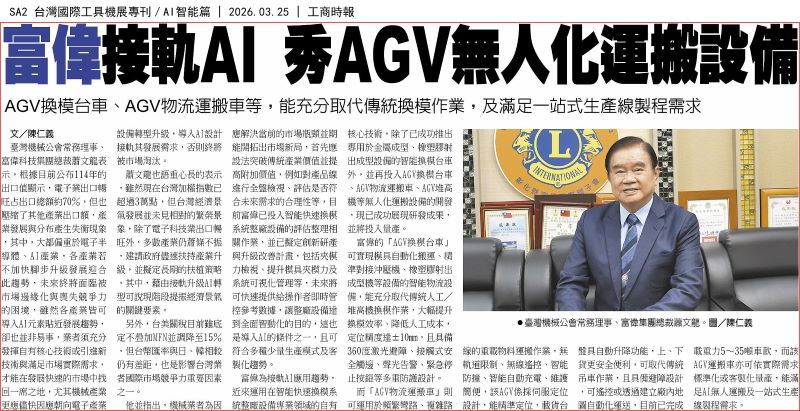
Hsiao Wen-lung, Executive Director of the Taiwan Association of Machinery Industry (TAMI) and President of Forwell Group, stated that according to the currently released export data for 2026 (Year 115), exports from the electronics industry are booming, accounting for approximately 70% of total exports. However, this has also squeezed the export value of other sectors, leading to an imbalance in industrial development and distribution. The focus is heavily skewed toward electronic semiconductors and the AI industry. If other industries do not accelerate their upgrades to align with this trend, they will eventually face marginalization and a loss of competitiveness. Although all industries can integrate AI elements to align with market trends, it is no easy task. Operators must fully leverage their core technologies or introduce new ones to meet actual market demands to regain a foothold in a rapidly evolving market. Specifically, the machinery industry must transition and upgrade toward electronic industry equipment and integrate AI design to meet development needs; otherwise, it will inevitably be eliminated by the market.
Hsiao also noted with concern that while the Taiwan Stock Exchange Capitalization Weighted Stock Index has surpassed 30,000 points, the overall economic development does not reflect a corresponding state of prosperity. Aside from the booming electronics and technology sectors, most industries remain stagnant. He urged the government to promptly support industrial upgrading and formulate long-term assistance strategies, noting that integrating AI transformation is a key element for boosting the economy at this stage. Furthermore, while Taiwan-US tariffs have finally been finalized—avoiding MFN accumulation and being reduced to 15%, aligning with Japan, South Korea, and the EU—the exchange rate of the New Taiwan Dollar still shows a gap of about 30% compared to the Japanese Yen and Korean Won, which remains a significant factor affecting the international competitiveness of Taiwanese businesses.
He pointed out that to overcome current market bottlenecks and open new horizons, machinery operators must first find ways to break through traditional industrial values and increase added value. This includes conducting a comprehensive review of product lines and assessing their rationality for future demands. Forwell has already begun evaluations and operations related to "Smart Quick Die Change Systems" for whole-plant equipment and has formulated innovative R&D and upgrade plans. these include clamping force inspection, enhancing die clamping force, and system visualization management. In the future, this will provide operators with real-time management data, achieving the goal of comprehensive automated intelligence for whole-plant equipment. This is also a prerequisite for AI integration and meets the trends of high-mix, low-volume production and customization.
To keep pace with AI application trends, Forwell has utilized its core technology in the professional field of Smart Quick Die Change Systems. In addition to successfully launching smart die-change carts specifically for metal forming and plastic injection molding equipment, the company has invested in the development of unmanned handling equipment such as AGV die-change carts, AGV logistics transport vehicles, and AGV forklifts. These R&D results are now being showcased and will soon enter mass production.
Forwell’s "AGV Die-Change Cart" is a smart logistics device capable of automated die handling and precise docking with equipment like stamping presses and plastic injection molding machines. it can fully replace traditional manual or forklift operations, significantly improving efficiency and reducing labor costs. It features a positioning accuracy of ±10mm and multiple safety designs, including 360-degree laser obstacle avoidance, contact safety edges, sound and light alarms, and emergency stop buttons.
The "AGV Logistics Transport Vehicle" is designed for heavy-load material handling on frequent turns and complex routes. It features no track restrictions, wireless remote control, smart anti-collision, smart auto-charging, and easy maintenance. The AGV adopts a servo positioning design for high precision, and the cargo platform has an automatic lifting function for safer and more convenient loading/unloading, replacing traditional crane operations. It includes obstacle avoidance and can be operated via remote control or automated based on an internal factory map. Currently, models with load capacities ranging from 5 to 35 tons have been completed. These AGV transport vehicles can be mass-produced as standardized or customized units to meet AI unmanned handling and one-stop production line requirements.
Hsiao Wen-lung, Executive Director of the Taiwan Association of Machinery Industry (TAMI) and President of Forwell Group, stated that according to the currently released export data for 2026 (Year 115), exports from the electronics industry are booming, accounting for approximately 70% of total exports. However, this has also squeezed the export value of other sectors, leading to an imbalance in industrial development and distribution. The focus is heavily skewed toward electronic semiconductors and the AI industry. If other industries do not accelerate their upgrades to align with this trend, they will eventually face marginalization and a loss of competitiveness. Although all industries can integrate AI elements to align with market trends, it is no easy task. Operators must fully leverage their core technologies or introduce new ones to meet actual market demands to regain a foothold in a rapidly evolving market. Specifically, the machinery industry must transition and upgrade toward electronic industry equipment and integrate AI design to meet development needs; otherwise, it will inevitably be eliminated by the market.
Hsiao also noted with concern that while the Taiwan Stock Exchange Capitalization Weighted Stock Index has surpassed 30,000 points, the overall economic development does not reflect a corresponding state of prosperity. Aside from the booming electronics and technology sectors, most industries remain stagnant. He urged the government to promptly support industrial upgrading and formulate long-term assistance strategies, noting that integrating AI transformation is a key element for boosting the economy at this stage. Furthermore, while Taiwan-US tariffs have finally been finalized—avoiding MFN accumulation and being reduced to 15%, aligning with Japan, South Korea, and the EU—the exchange rate of the New Taiwan Dollar still shows a gap of about 30% compared to the Japanese Yen and Korean Won, which remains a significant factor affecting the international competitiveness of Taiwanese businesses.
He pointed out that to overcome current market bottlenecks and open new horizons, machinery operators must first find ways to break through traditional industrial values and increase added value. This includes conducting a comprehensive review of product lines and assessing their rationality for future demands. Forwell has already begun evaluations and operations related to "Smart Quick Die Change Systems" for whole-plant equipment and has formulated innovative R&D and upgrade plans. these include clamping force inspection, enhancing die clamping force, and system visualization management. In the future, this will provide operators with real-time management data, achieving the goal of comprehensive automated intelligence for whole-plant equipment. This is also a prerequisite for AI integration and meets the trends of high-mix, low-volume production and customization.
To keep pace with AI application trends, Forwell has utilized its core technology in the professional field of Smart Quick Die Change Systems. In addition to successfully launching smart die-change carts specifically for metal forming and plastic injection molding equipment, the company has invested in the development of unmanned handling equipment such as AGV die-change carts, AGV logistics transport vehicles, and AGV forklifts. These R&D results are now being showcased and will soon enter mass production.
Forwell’s "AGV Die-Change Cart" is a smart logistics device capable of automated die handling and precise docking with equipment like stamping presses and plastic injection molding machines. it can fully replace traditional manual or forklift operations, significantly improving efficiency and reducing labor costs. It features a positioning accuracy of ±10mm and multiple safety designs, including 360-degree laser obstacle avoidance, contact safety edges, sound and light alarms, and emergency stop buttons.
The "AGV Logistics Transport Vehicle" is designed for heavy-load material handling on frequent turns and complex routes. It features no track restrictions, wireless remote control, smart anti-collision, smart auto-charging, and easy maintenance. The AGV adopts a servo positioning design for high precision, and the cargo platform has an automatic lifting function for safer and more convenient loading/unloading, replacing traditional crane operations. It includes obstacle avoidance and can be operated via remote control or automated based on an internal factory map. Currently, models with load capacities ranging from 5 to 35 tons have been completed. These AGV transport vehicles can be mass-produced as standardized or customized units to meet AI unmanned handling and one-stop production line requirements.