

Home
News
Forwell’s Intelligent Mold Management System enables high-frequency mold changes, achieving efficient and safe smart manufacturing production goals.
By Chen Jen-yi
The highly advanced pursuit of production goals such as environmental protection, energy efficiency, lightweighting, durability, and smart technology is the current trend in the global automotive industry. To simultaneously achieve high quality, high productivity, and cost reduction, automotive component manufacturers are constantly innovating manufacturing technologies and refining production equipment. Notably, beyond traditional metal sheet parts, many components now utilize composite materials combining rubber, plastics, iron, and aluminum. The quality and precision of materials have significantly improved, and mold technology continues to advance with increasing precision. Components that previously required multiple molds can now be completed with just one, simplifying processes and greatly enhancing production efficiency and quality.
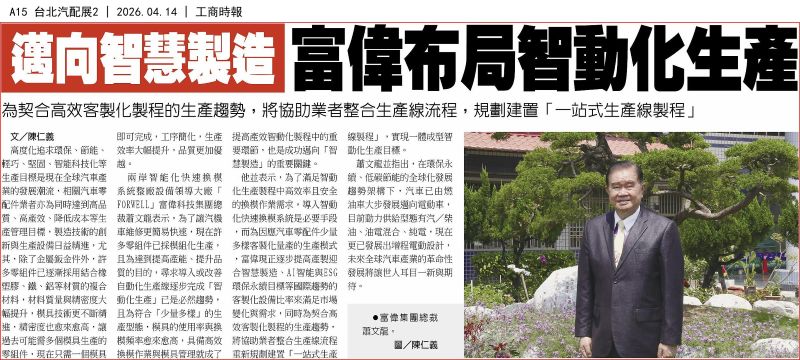
Hsiao Wen-lung, Chairman of FORWELL IT Group—a leading manufacturer of turnkey intelligent quick mold change systems across the Taiwan Strait—stated that to make vehicle maintenance easier and faster, many components are now produced through modular manufacturing. To increase capacity and quality, adopting or improving automated production lines to achieve "intelligent automation" has become an inevitable trend. Furthermore, to accommodate "small-volume, large-variety" production models, the utilization and frequency of mold changes are rising. Efficient mold change operations and mold management have thus become vital links in improving productivity within intelligent automated processes and are key to successfully transitioning to "smart manufacturing."
He further noted that to meet the demand for efficient and safe mold changes in intelligent production processes, the introduction of intelligent quick mold change systems is essential. In response to the customized mass production of automotive parts, FORWELL is gradually increasing the proportion of customized equipment that aligns with international trends such as smart manufacturing, AI intelligence, and ESG sustainability goals. To meet the trend of high-efficiency customized manufacturing, the company will assist industries in integrating production line workflows and re-planning the establishment of "one-stop production lines" to achieve the goal of integrated, intelligent automated production.
Hsiao also pointed out that under the global framework of environmental sustainability and low-carbon energy saving, automobiles have made great strides from internal combustion engines to electric vehicles. Current power supply types include gasoline/diesel, hybrid, and pure electric; furthermore, extended-range electric designs have emerged. The future revolutionary developments in the global automotive industry are expected to be both refreshing and highly anticipated.
The highly advanced pursuit of production goals such as environmental protection, energy efficiency, lightweighting, durability, and smart technology is the current trend in the global automotive industry. To simultaneously achieve high quality, high productivity, and cost reduction, automotive component manufacturers are constantly innovating manufacturing technologies and refining production equipment. Notably, beyond traditional metal sheet parts, many components now utilize composite materials combining rubber, plastics, iron, and aluminum. The quality and precision of materials have significantly improved, and mold technology continues to advance with increasing precision. Components that previously required multiple molds can now be completed with just one, simplifying processes and greatly enhancing production efficiency and quality.
Hsiao Wen-lung, Chairman of FORWELL IT Group—a leading manufacturer of turnkey intelligent quick mold change systems across the Taiwan Strait—stated that to make vehicle maintenance easier and faster, many components are now produced through modular manufacturing. To increase capacity and quality, adopting or improving automated production lines to achieve "intelligent automation" has become an inevitable trend. Furthermore, to accommodate "small-volume, large-variety" production models, the utilization and frequency of mold changes are rising. Efficient mold change operations and mold management have thus become vital links in improving productivity within intelligent automated processes and are key to successfully transitioning to "smart manufacturing."
He further noted that to meet the demand for efficient and safe mold changes in intelligent production processes, the introduction of intelligent quick mold change systems is essential. In response to the customized mass production of automotive parts, FORWELL is gradually increasing the proportion of customized equipment that aligns with international trends such as smart manufacturing, AI intelligence, and ESG sustainability goals. To meet the trend of high-efficiency customized manufacturing, the company will assist industries in integrating production line workflows and re-planning the establishment of "one-stop production lines" to achieve the goal of integrated, intelligent automated production.
Hsiao also pointed out that under the global framework of environmental sustainability and low-carbon energy saving, automobiles have made great strides from internal combustion engines to electric vehicles. Current power supply types include gasoline/diesel, hybrid, and pure electric; furthermore, extended-range electric designs have emerged. The future revolutionary developments in the global automotive industry are expected to be both refreshing and highly anticipated.