

Home
News
Forwell Chairman Hsiao Wen-lung Urges Industry to Embrace the AI Manufacturing Upgrade Trend
By Chen Jen-yi
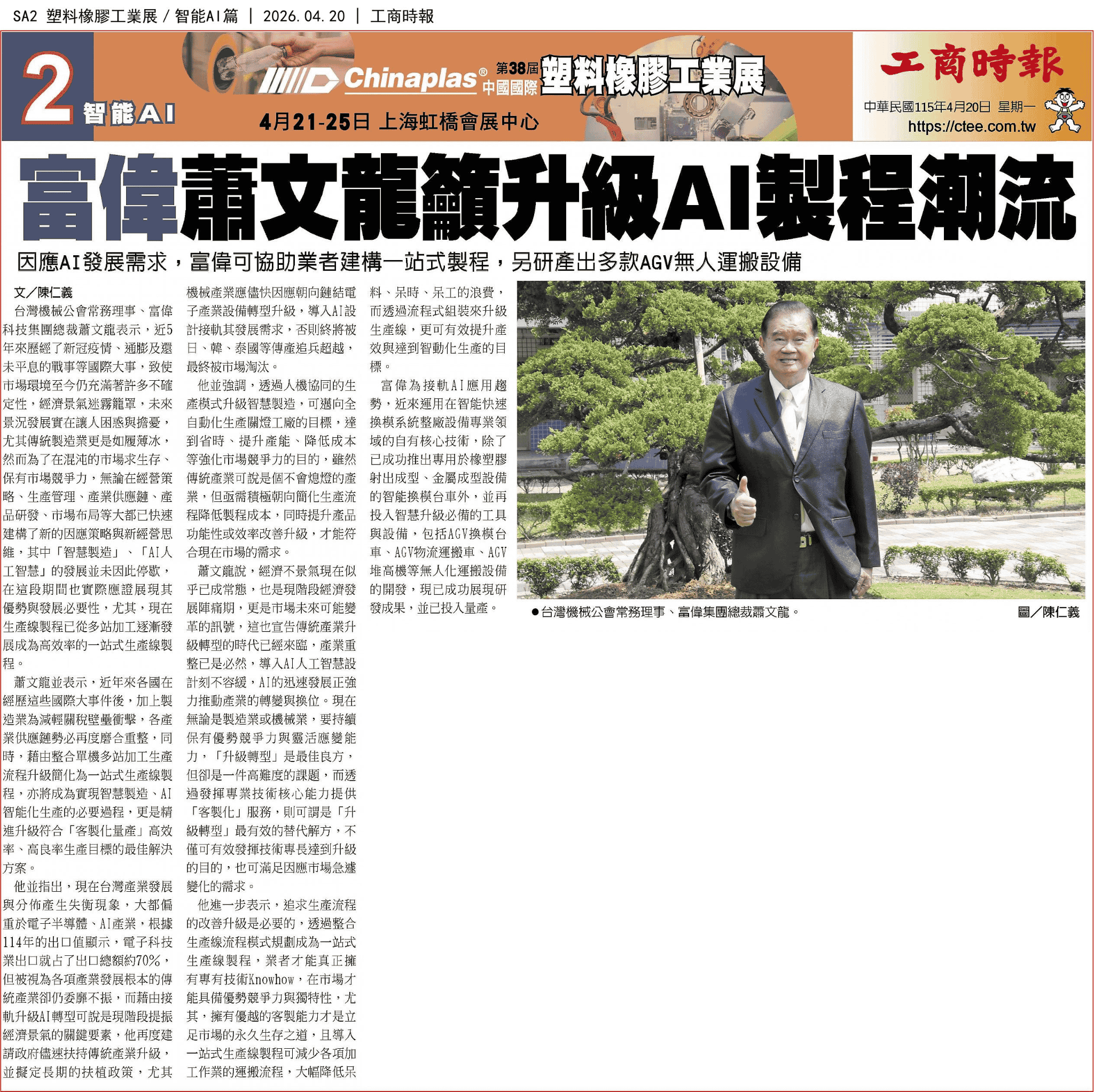
Hsiao Wen-lung, Executive Director of the Taiwan Association of Machinery Industry and Chairman of FORWELL IT Group, stated that the past five years have been marked by significant international events, including the COVID-19 pandemic, inflation, and ongoing conflicts. These factors have left the market environment riddled with uncertainty and shrouded in economic fog, making future developments a source of confusion and concern, particularly for traditional manufacturing industries operating under high pressure. However, to survive and maintain competitiveness in a chaotic market, most companies have rapidly constructed new strategies and management mindsets across business operations, production management, supply chains, R&D, and market positioning. Notably, the development of "Smart Manufacturing" and "Artificial Intelligence (AI)" has not stalled; instead, this period has validated their advantages and necessity. Specifically, production processes are evolving from multi-station processing toward highly efficient "one-stop" production lines.
Hsiao also noted that as countries navigate these global events and as manufacturers seek to mitigate the impact of tariff barriers, industry supply chains are bound to undergo realignment. Simultaneously, upgrading and simplifying multi-station processing into one-stop production lines will be an essential step toward achieving smart manufacturing and AI-driven production. This represents the optimal solution for achieving high efficiency and high yield in "customized mass production."
He further pointed out an imbalance in Taiwan’s industrial development, which leans heavily toward electronic semiconductors and the AI sector. According to export data for 2025 (Year 114), electronic technology accounted for approximately 70% of total exports, while traditional industries—the foundation of all industrial development—remain sluggish. Integrating AI for transformation is a key factor in boosting the current economy. He again urged the government to support traditional industry upgrades with long-term policies. Specifically, the machinery industry must transition toward linking with electronic industry equipment and adopting AI design to meet evolving demands; otherwise, it risks being overtaken by competitors in Japan, South Korea, and Thailand, and ultimately facing market obsolescence.
He emphasized that upgrading to smart manufacturing through human-machine collaboration can lead to the goal of fully automated "lights-out" factories, saving time, increasing capacity, and reducing costs to strengthen market competitiveness. While traditional manufacturing is an "evergreen" industry, it urgently needs to simplify processes to lower costs while enhancing product functionality and efficiency to meet modern market demands.
Hsiao remarked that economic downturns now seem to be the norm, representing a painful period of transition and a signal of future market shifts. This heralds the era of traditional industry transformation. Industrial restructuring is inevitable, and the integration of AI design is urgent, as its rapid development is driving industrial shifts and repositioning. For both the manufacturing and machinery sectors, "upgrading and transformation" is the best remedy for maintaining competitiveness and agility, though it remains a challenging task. Providing "customized" services by leveraging core technical expertise is the most effective alternative for transformation, allowing companies to utilize their specialties while satisfying rapidly changing market needs.
He further stated that improving production workflows is vital. By integrating workflows into a one-stop production model, companies can secure their proprietary know-how and maintain a unique competitive edge. Superior customization capability is the ultimate way to survive in the market. Furthermore, implementing one-stop production lines reduces the transport involved in various processes, significantly minimizing waste in materials, time, and labor. Upgrading production lines through flow-based assembly can effectively boost productivity and achieve intelligent automation goals.
To align with AI application trends, FORWELL has recently utilized its core technology in the professional field of turnkey intelligent quick mold change systems. In addition to successfully launching intelligent mold change carts for rubber/plastic injection molding and metal forming equipment, the company has invested in essential tools for smart upgrades. This includes the development of unmanned handling equipment such as AGV mold change carts, AGV logistics vehicles, and AGV forklifts. These R&D achievements have been successfully realized and are now in mass production.
Hsiao Wen-lung, Executive Director of the Taiwan Association of Machinery Industry and Chairman of FORWELL IT Group, stated that the past five years have been marked by significant international events, including the COVID-19 pandemic, inflation, and ongoing conflicts. These factors have left the market environment riddled with uncertainty and shrouded in economic fog, making future developments a source of confusion and concern, particularly for traditional manufacturing industries operating under high pressure. However, to survive and maintain competitiveness in a chaotic market, most companies have rapidly constructed new strategies and management mindsets across business operations, production management, supply chains, R&D, and market positioning. Notably, the development of "Smart Manufacturing" and "Artificial Intelligence (AI)" has not stalled; instead, this period has validated their advantages and necessity. Specifically, production processes are evolving from multi-station processing toward highly efficient "one-stop" production lines.
Hsiao also noted that as countries navigate these global events and as manufacturers seek to mitigate the impact of tariff barriers, industry supply chains are bound to undergo realignment. Simultaneously, upgrading and simplifying multi-station processing into one-stop production lines will be an essential step toward achieving smart manufacturing and AI-driven production. This represents the optimal solution for achieving high efficiency and high yield in "customized mass production."
He further pointed out an imbalance in Taiwan’s industrial development, which leans heavily toward electronic semiconductors and the AI sector. According to export data for 2025 (Year 114), electronic technology accounted for approximately 70% of total exports, while traditional industries—the foundation of all industrial development—remain sluggish. Integrating AI for transformation is a key factor in boosting the current economy. He again urged the government to support traditional industry upgrades with long-term policies. Specifically, the machinery industry must transition toward linking with electronic industry equipment and adopting AI design to meet evolving demands; otherwise, it risks being overtaken by competitors in Japan, South Korea, and Thailand, and ultimately facing market obsolescence.
He emphasized that upgrading to smart manufacturing through human-machine collaboration can lead to the goal of fully automated "lights-out" factories, saving time, increasing capacity, and reducing costs to strengthen market competitiveness. While traditional manufacturing is an "evergreen" industry, it urgently needs to simplify processes to lower costs while enhancing product functionality and efficiency to meet modern market demands.
Hsiao remarked that economic downturns now seem to be the norm, representing a painful period of transition and a signal of future market shifts. This heralds the era of traditional industry transformation. Industrial restructuring is inevitable, and the integration of AI design is urgent, as its rapid development is driving industrial shifts and repositioning. For both the manufacturing and machinery sectors, "upgrading and transformation" is the best remedy for maintaining competitiveness and agility, though it remains a challenging task. Providing "customized" services by leveraging core technical expertise is the most effective alternative for transformation, allowing companies to utilize their specialties while satisfying rapidly changing market needs.
He further stated that improving production workflows is vital. By integrating workflows into a one-stop production model, companies can secure their proprietary know-how and maintain a unique competitive edge. Superior customization capability is the ultimate way to survive in the market. Furthermore, implementing one-stop production lines reduces the transport involved in various processes, significantly minimizing waste in materials, time, and labor. Upgrading production lines through flow-based assembly can effectively boost productivity and achieve intelligent automation goals.
To align with AI application trends, FORWELL has recently utilized its core technology in the professional field of turnkey intelligent quick mold change systems. In addition to successfully launching intelligent mold change carts for rubber/plastic injection molding and metal forming equipment, the company has invested in essential tools for smart upgrades. This includes the development of unmanned handling equipment such as AGV mold change carts, AGV logistics vehicles, and AGV forklifts. These R&D achievements have been successfully realized and are now in mass production.