



Home
News
Forwell’s Hsiao Wen-Lung: Developing Integrated Production Composite Machinery to Meet the AI Era and Create New Market Value
By Chen Jen-Yi
Hsiao Wen-Lung, Standing Director of the Taiwan Association of Machinery Industry and President of Forwell Technology Group, stated that although the traditional industries have shown some signs of recovery, there are still no clear signals of stable upward growth, and a wait-and-see sentiment remains strong. The machinery industry, in particular, continues to face a challenging market environment, leading industry players to lament that “economic downturns have become the new normal.” However, as the wave of AI sweeps across the globe, artificial intelligence has become an inevitable trend that industries are competing to embrace. The rapid development of the information, communications and electronics industries in recent years is clear evidence of this trend. For the machinery industry, only through upgrading and transformation can it return to the market track, quickly align with actual market needs and development trends, and create a new milestone for the machinery industry.
Hsiao Wen-Lung further pointed out that traditional industries are now facing the impact of the AI trend and are gradually being marginalized by the market. They are also confronted with severe challenges, including supply chain imbalances and disruptions, forced changes in industrial structures, limited profit margins, and difficulties in controlling delivery schedules. The machinery industry is no exception. How to upgrade and transform by incorporating AI concepts and designs that meet market demands has therefore become a critical issue concerning the survival and development of traditional industries. Business operators urgently need to propose proactive solutions in order to lead their companies forward toward the next milestone.
He further explained that, in response to the production models and efficiency requirements of the AI era, machine tools and industrial machinery will move toward integrated and composite designs that combine production processes and manufacturing steps, enabling rapid “all-in-one” production. The industry will gradually move away from single-machine processing and toward highly customized machinery that integrates multiple manufacturing and processing methods. This represents a major transformation and upgrade that breaks away from traditional production models, while also presenting a significant challenge. Forwell is also actively developing innovative R&D plans to support upgrading and transformation in line with AI application trends, injecting new market momentum and innovative value into the company’s new products.
Hsiao Wen-Lung also noted that, in order to stimulate the domestic economy and help local industries achieve comprehensive transformation and upgrading in line with the global trend of AI applications, the government is urged to establish incentive programs for the replacement and upgrading of equipment in traditional industries, with investment tax credits comparable to those offered to the electronics and technology industries. Such measures could not only assist and guide traditional industries in completing various upgrading and transformation projects, including AI and integrated production processes, at an earlier stage, but also create market demand and revitalize domestic economic development.
To embrace AI applications, Forwell Technology Group has recently leveraged its proprietary core technologies in the professional field of intelligent rapid die change systems and turnkey plant equipment. In addition to successfully launching intelligent die change carts specifically designed for metal forming and rubber and plastic injection molding equipment, the Group has further invested in the development and production of unmanned material handling equipment, including AGV die change carts, AGV logistics vehicles, and AGV forklifts, which have now entered mass production.
Among these products, Forwell’s “AGV Die Change Cart” is an intelligent logistics solution capable of automated mold transportation and precise docking with equipment such as stamping presses and injection molding machines. It can replace traditional manual or forklift-based die change operations, significantly improving die change efficiency and reducing labor costs. It offers positioning accuracy of ±10 mm and incorporates multiple safety features, including 360-degree laser obstacle avoidance, contact safety edges, audible and visual alarms, and emergency stop buttons. The “AGV Logistics Vehicle,” meanwhile, is designed for material handling operations involving frequent turns and complex routes. It features wireless remote control, intelligent collision prevention and error-proofing, obstacle avoidance, and automatic charging. Equipped with a servo positioning system, it enables precise automatic positioning, while its loading platform features automatic lifting and lowering functions for safer and more convenient loading and unloading. Models ranging from 5 to 35 tons have already been completed, with further development underway for high-capacity models of 50, 65, 80, and 100 tons.
Hsiao Wen-Lung, Standing Director of the Taiwan Association of Machinery Industry and President of Forwell Technology Group, stated that although the traditional industries have shown some signs of recovery, there are still no clear signals of stable upward growth, and a wait-and-see sentiment remains strong. The machinery industry, in particular, continues to face a challenging market environment, leading industry players to lament that “economic downturns have become the new normal.” However, as the wave of AI sweeps across the globe, artificial intelligence has become an inevitable trend that industries are competing to embrace. The rapid development of the information, communications and electronics industries in recent years is clear evidence of this trend. For the machinery industry, only through upgrading and transformation can it return to the market track, quickly align with actual market needs and development trends, and create a new milestone for the machinery industry.
Hsiao Wen-Lung further pointed out that traditional industries are now facing the impact of the AI trend and are gradually being marginalized by the market. They are also confronted with severe challenges, including supply chain imbalances and disruptions, forced changes in industrial structures, limited profit margins, and difficulties in controlling delivery schedules. The machinery industry is no exception. How to upgrade and transform by incorporating AI concepts and designs that meet market demands has therefore become a critical issue concerning the survival and development of traditional industries. Business operators urgently need to propose proactive solutions in order to lead their companies forward toward the next milestone.
He further explained that, in response to the production models and efficiency requirements of the AI era, machine tools and industrial machinery will move toward integrated and composite designs that combine production processes and manufacturing steps, enabling rapid “all-in-one” production. The industry will gradually move away from single-machine processing and toward highly customized machinery that integrates multiple manufacturing and processing methods. This represents a major transformation and upgrade that breaks away from traditional production models, while also presenting a significant challenge. Forwell is also actively developing innovative R&D plans to support upgrading and transformation in line with AI application trends, injecting new market momentum and innovative value into the company’s new products.
Hsiao Wen-Lung also noted that, in order to stimulate the domestic economy and help local industries achieve comprehensive transformation and upgrading in line with the global trend of AI applications, the government is urged to establish incentive programs for the replacement and upgrading of equipment in traditional industries, with investment tax credits comparable to those offered to the electronics and technology industries. Such measures could not only assist and guide traditional industries in completing various upgrading and transformation projects, including AI and integrated production processes, at an earlier stage, but also create market demand and revitalize domestic economic development.
To embrace AI applications, Forwell Technology Group has recently leveraged its proprietary core technologies in the professional field of intelligent rapid die change systems and turnkey plant equipment. In addition to successfully launching intelligent die change carts specifically designed for metal forming and rubber and plastic injection molding equipment, the Group has further invested in the development and production of unmanned material handling equipment, including AGV die change carts, AGV logistics vehicles, and AGV forklifts, which have now entered mass production.
Among these products, Forwell’s “AGV Die Change Cart” is an intelligent logistics solution capable of automated mold transportation and precise docking with equipment such as stamping presses and injection molding machines. It can replace traditional manual or forklift-based die change operations, significantly improving die change efficiency and reducing labor costs. It offers positioning accuracy of ±10 mm and incorporates multiple safety features, including 360-degree laser obstacle avoidance, contact safety edges, audible and visual alarms, and emergency stop buttons. The “AGV Logistics Vehicle,” meanwhile, is designed for material handling operations involving frequent turns and complex routes. It features wireless remote control, intelligent collision prevention and error-proofing, obstacle avoidance, and automatic charging. Equipped with a servo positioning system, it enables precise automatic positioning, while its loading platform features automatic lifting and lowering functions for safer and more convenient loading and unloading. Models ranging from 5 to 35 tons have already been completed, with further development underway for high-capacity models of 50, 65, 80, and 100 tons.
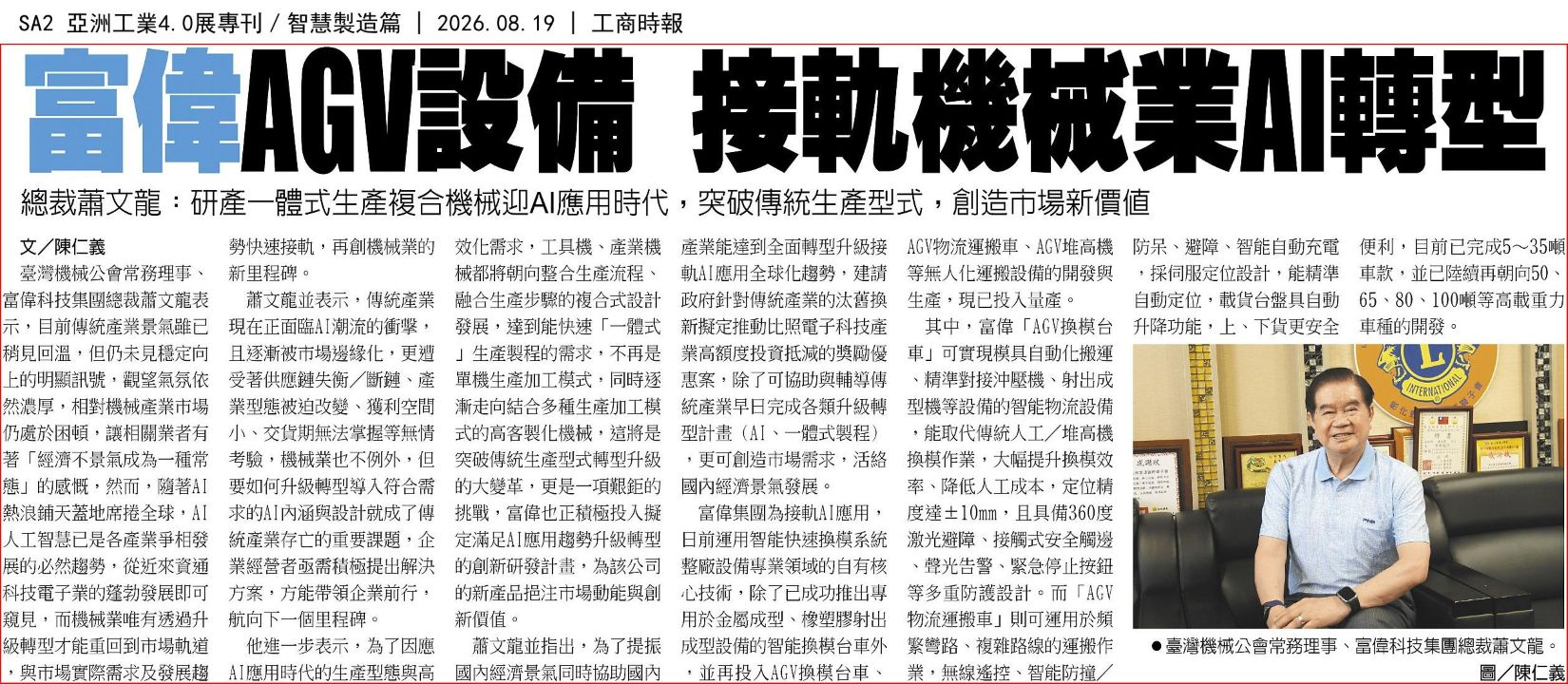 Hsiao Wen-Lung, Standing Director of the Taiwan Association of Machinery Industry and President of Forwell Technology Group. Photo/Chen Jen-Yi