



Home
News
Forwell President Hsiao Wen-Lung: Upgrading to “Integrated” Production Processes to Meet High-Efficiency Demands Is Key to Staying Competitive
By Chen Jen-Yi
Hsiao Wen-Lung, Standing Director of the Taiwan Association of Machinery Industry and President of FORWELL Technology Group, stated that AI is comprehensively reshaping global society, economic structures, industrial supply chains, daily life and the workplace. Its impact on manufacturing is especially profound: it is not only driving the continued expansion of the global industrial economy, but is also fundamentally changing how factories operate, how supply chains are structured and how products are designed. The explosive growth of AI is forcing most industries to transform quickly to meet the needs of new market models. In particular, introducing AI upgrades, higher intelligence and integrated unmanned production into rubber/plastic injection molding and metal forming equipment has become both a current and future trend. How to successfully upgrade and adopt AI content and design that truly meets actual needs has therefore become the key to whether manufacturers can continue to stand firm in the market.
Hsiao pointed out that, to respond to the production models and high-efficiency demands of the AI era, machine tools and industrial machinery will move toward composite designs that integrate production processes and merge production steps, enabling fast “integrated” production instead of single-machine processing. Machinery will also gradually evolve into highly customized equipment that combines multiple processing methods, with machines becoming larger and tonnages increasing. This will be a major transformation that breaks through traditional production methods. To meet high-productivity requirements, some production lines using today’s widely adopted rubber/plastic injection molding equipment may gradually be replaced by vacuum forming machines, which simplify processes and reduce mold usage. Plastic-steel composite materials, thanks to their improved hardness, light weight and high moldability, are also expected to gradually replace metal materials in the future.
FORWELL Group, a leading manufacturer of turnkey intelligent quick mold change systems across Taiwan and China, was the first on both sides of the Strait to develop an “Intelligent Mold Management System.” The system covers three major subsystems: the “Mold Transport System” (automatic mold change cart system), the “Automatic Mold Storage System” and the “Mold Maintenance System.” Through professional planning, it helps rubber/plastic injection molding and metal forming manufacturers build a fast, efficient, safe, easy and systematic one-stop “smart automation” management system for their molds. Amid the international trend of Industry 4.0 smart manufacturing, it enables rubber/plastic and metal forming manufacturers to achieve AI-driven intelligent production sooner.
At the same time, to align with AI application trends, Forwell has recently leveraged its proprietary core technologies in turnkey intelligent quick mold change systems. In addition to successfully launching intelligent mold change carts designed for injection molding machines and metal forming machines, the company has further invested in developing the tools and equipment essential for AI upgrades, including unmanned transport equipment such as AGV mold change carts, AGV logistics transport vehicles and AGV forklifts. These R&D efforts have already produced results and entered mass production.
Among them, Forwell’s “AGV Mold Change Cart” is an intelligent logistics device that enables automated mold transport and precise docking with equipment such as rubber/plastic injection molding machines and stamping presses. It can fully replace traditional manual/forklift mold change operations and significantly improves mold change efficiency. With a positioning accuracy of ±10mm, it is equipped with multiple safety features, including 360-degree laser obstacle avoidance, contact safety edges, sound and light alarms, and emergency stop buttons.
The “AGV Logistics Transport Vehicle” can be used for heavy-load material handling along complex routes. It also adopts a servo positioning design for precise automatic positioning and is equipped with obstacle avoidance. It can be operated by remote control or run automatically using an in-plant map, meeting the needs of unmanned transport and one-stop production line processes. Models with load capacities of 5 to 35 tons have been completed, and development is now underway for higher-capacity models of up to 100 tons, with standardized or customized mass production available according to actual needs.
Looking ahead, Hsiao believes that demand for AI, high-performance computing and cloud applications is expanding rapidly, and that continued strong demand in the AI-driven real economy is expected to partially offset the negative impact of geopolitical tensions from the U.S.-Iran conflict, allowing economies deeply involved in the global technology value chain to maintain steady growth. Even so, traditional industries are still affected by structural factors such as weak global demand, intensifying price competition from mainland China, resource crowding-out effects and transformation pressure, leaving most manufacturers with a cautious, flat outlook on the economy. When the economy will return to its former strength remains to be seen, but companies can first prepare for the arrival of the AI era.
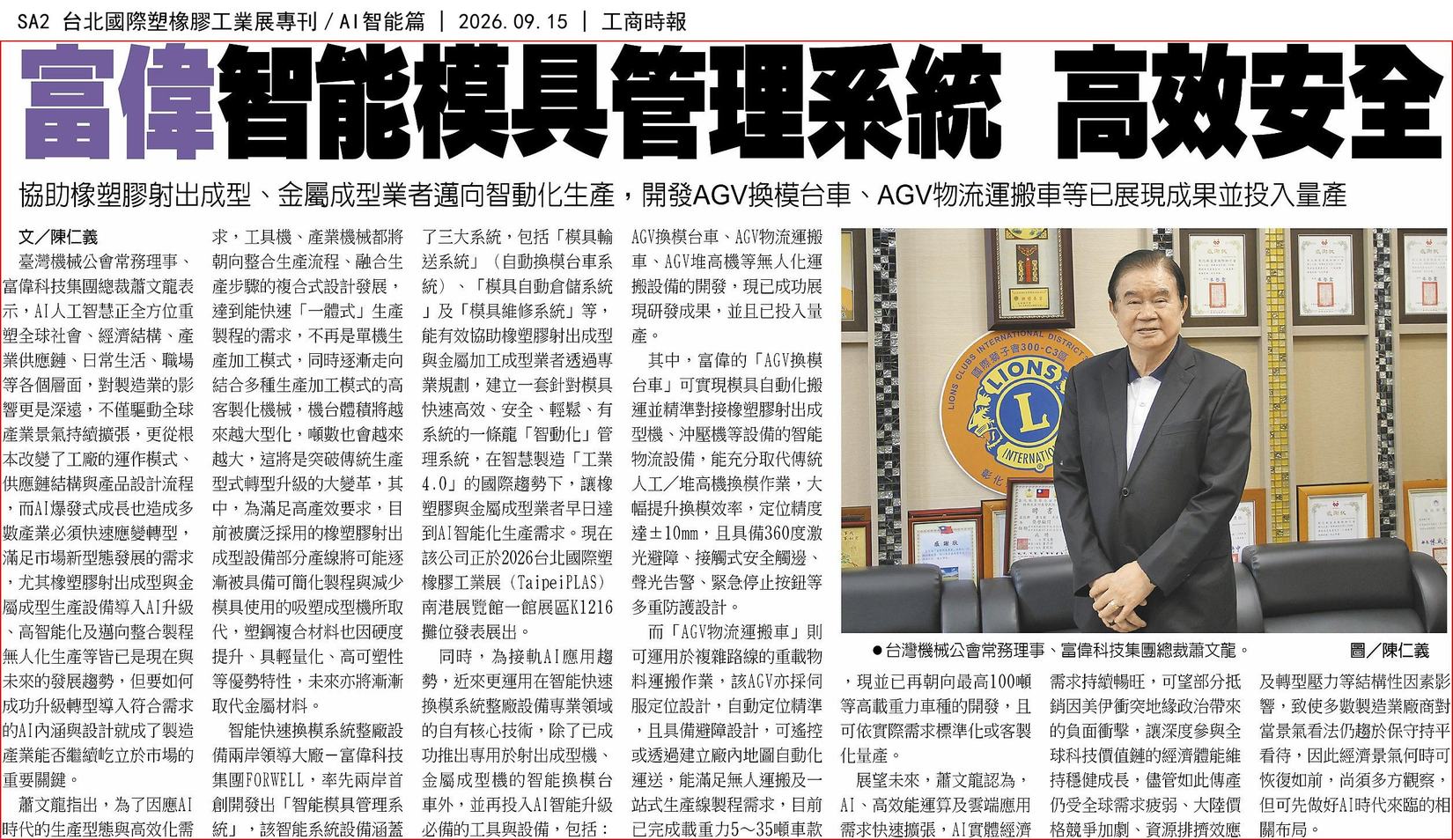 Hsiao Wen-Lung, Standing Director of the Taiwan Association of Machinery Industry and President of Forwell Group. Photo/Chen Jen-Yi